Flanges are manufactured with various facing configurations to suit gasket type, pressure class, and service requirements.
1. Raised Face – RF
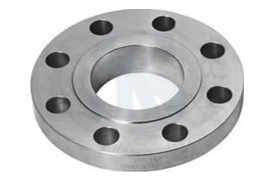
A raised face flange has a gasket seating surface that is elevated above the bolt circle. This is the most commonly used facing in ASME B16.5 flanges.
Raised face flanges are suitable for use with flat ring sheet gaskets and metallic gaskets, including ring-type and double-jacketed gaskets.
The raised face concentrates bolt load over a reduced gasket contact area, thereby improving sealing performance under pressure. In accordance with ASME B16.5, the raised face diameter and height are determined by the pressure class and nominal pipe size (NPS). The pressure class governs the raised face height.
The standard flange facing surface finish per ASME B16.5 is 125–250 μin Ra (3–6 μm Ra).
Typical ASME B16.5 flange facing finish is
125–250 μin Ra (3–6 μm Ra).
Raised Face Height (ASME B16.5):
These dimensions apply to all flange types except lap joint flanges.
2. Flat Face – FF
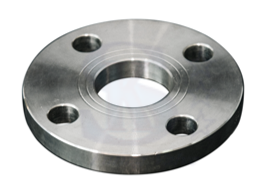
A flat face flange has a gasket seating surface that is flush with the flange face across its full diameter.
Flat face flanges are typically used for cast iron flanges (Class 125) and flanges manufactured from brittle materials. These flanges shall be used with full-face gaskets to minimize flange bending stresses and reduce the risk of cracking during bolt tightening.
Flat face flanges shall not be mated with raised face flanges.
3. Tongue and Groove – TG
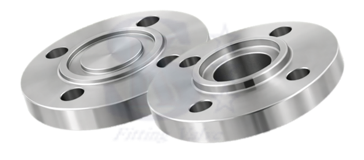
Tongue and groove facings are supplied as matched pairs. One flange is provided with a raised tongue, and the mating flange contains a corresponding groove.
Tongue and groove facings are available in large and small configurations. Unlike male-and-female facings, the internal diameter of the tongue and groove does not extend to the flange bore, providing positive gasket confinement on both the inside and outside diameters. This facing type is commonly used for pump covers and valve bonnets.
Tongue and groove joints are self-aligning and provide reliable gasket compression. The gasket is fully retained, resulting in improved sealing integrity without the need for excessive bolt loads.
Flange facings such as RTJ, T&G, and M&F shall not be intermixed, as their sealing surfaces are not compatible and cannot be effectively sealed with a common gasket.
4. Male-and-Female – M&F
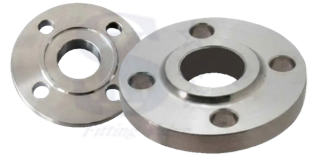
In a male-and-female facing, one flange is machined with a raised male projection, while the mating flange contains a corresponding female recess.
The female recess is typically 3/16 in deep, and the male projection is 1/4 in high. Both gasket seating surfaces are flat. The outside diameter of the female face provides positive gasket location and support.
Advantages and Limitations of T&G and M&F Facings
Advantages: 


