
- Home
- News and Articles
- EPDM vs NBR Flexible Rubber Joints: Material Comparison for Piping Systems
Selecting the appropriate material for a flexible rubber joint is a critical factor affecting durability, performance, and safety in system applications.
Flexible rubber joints—commonly referred to as rubber flex joints—are widely used in piping systems, machinery, and applications requiring vibration absorption or movement compensation. Among synthetic rubber materials, the most commonly used are EPDM and NBR. These two primary options have clearly different properties. Understanding the differences between EPDM vs NBR enables engineers to select the most suitable rubber flex joint for actual operating conditions.
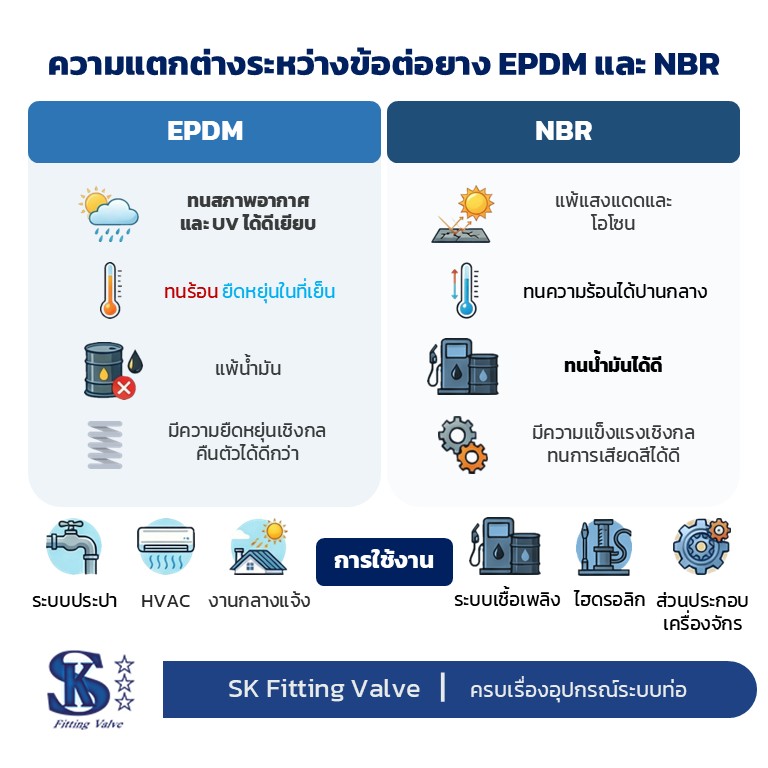
EPDM Rubber Joints
EPDM (Ethylene Propylene Diene Monomer) is a synthetic rubber known for its excellent resistance to environmental conditions. EPDM maintains flexibility across a wide temperature range, typically from approximately -50°C to +150°C, depending on formulation and manufacturing process.
EPDM flexible rubber joints are ideal for applications exposed to outdoor environments, water, and steam. Due to its superior resistance to UV radiation, ozone, and steam, EPDM is widely used in industrial piping systems, HVAC systems, cooling water systems, and applications requiring long service life.
However, EPDM is not suitable for applications involving petroleum oils or greases, as the material may swell and deteriorate when exposed to such substances.
NBR Rubber Joints
NBR (Nitrile Butadiene Rubber, also known as Buna-N) is a synthetic rubber distinguished by its strong resistance to oils, fuels, and petroleum-based substances. As a result, NBR flexible joints are commonly selected for oil systems, hydraulic systems, and the automotive industry.
The operating temperature range of NBR is approximately -40°C to +100°C, making it suitable for indoor applications or moderate-temperature environments. NBR rubber joints offer good mechanical strength and abrasion resistance, enabling them to withstand pressure and repeated movement effectively.
However, NBR has poor resistance to UV radiation and ozone, making it unsuitable for long-term outdoor use.
Key Property Comparison: EPDM vs NBR
Guidelines for Selecting Flexible Rubber Joints
Conclusion
Flexible rubber joints manufactured from EPDM and NBR each offer distinct advantages. Selecting the appropriate material based on temperature, chemical exposure, and environmental conditions enhances sealing performance, reduces maintenance requirements, and extends the service life of piping systems and machinery.
Flexible rubber joints—commonly referred to as rubber flex joints—are widely used in piping systems, machinery, and applications requiring vibration absorption or movement compensation. Among synthetic rubber materials, the most commonly used are EPDM and NBR. These two primary options have clearly different properties. Understanding the differences between EPDM vs NBR enables engineers to select the most suitable rubber flex joint for actual operating conditions.
EPDM Rubber Joints
EPDM (Ethylene Propylene Diene Monomer) is a synthetic rubber known for its excellent resistance to environmental conditions. EPDM maintains flexibility across a wide temperature range, typically from approximately -50°C to +150°C, depending on formulation and manufacturing process.
EPDM flexible rubber joints are ideal for applications exposed to outdoor environments, water, and steam. Due to its superior resistance to UV radiation, ozone, and steam, EPDM is widely used in industrial piping systems, HVAC systems, cooling water systems, and applications requiring long service life.
However, EPDM is not suitable for applications involving petroleum oils or greases, as the material may swell and deteriorate when exposed to such substances.
NBR Rubber Joints
NBR (Nitrile Butadiene Rubber, also known as Buna-N) is a synthetic rubber distinguished by its strong resistance to oils, fuels, and petroleum-based substances. As a result, NBR flexible joints are commonly selected for oil systems, hydraulic systems, and the automotive industry.
The operating temperature range of NBR is approximately -40°C to +100°C, making it suitable for indoor applications or moderate-temperature environments. NBR rubber joints offer good mechanical strength and abrasion resistance, enabling them to withstand pressure and repeated movement effectively.
However, NBR has poor resistance to UV radiation and ozone, making it unsuitable for long-term outdoor use.
Key Property Comparison: EPDM vs NBR
- Temperature Resistance: EPDM has an advantage over NBR, especially in high-temperature or harsh environments.
- Chemical Resistance: NBR is suitable for oils and fuels, whereas EPDM performs well with water, steam, and polar substances.
- Outdoor Performance: EPDM offers significantly better UV and ozone resistance.
- Elasticity and Elongation: EPDM provides higher elongation, while NBR offers stronger mechanical strength and better abrasion resistance.
Guidelines for Selecting Flexible Rubber Joints
- Choose EPDM rubber joints for water systems, steam systems, outdoor applications, HVAC systems, and weather-exposed environments.
- Choose NBR rubber joints for oil systems, fuel systems, hydraulic systems, and pressurized indoor industrial applications.
Conclusion
Flexible rubber joints manufactured from EPDM and NBR each offer distinct advantages. Selecting the appropriate material based on temperature, chemical exposure, and environmental conditions enhances sealing performance, reduces maintenance requirements, and extends the service life of piping systems and machinery.
Share this post :
Related Reference

Flange Marking Explained: How to Read Flange marking
Flange marking refers to the information stamped or engraved on a flange to identify its specifications. These markings allow e...


Safety Valve With Lever vs Without Lever
A safety valve — also called a pressure safety valve — is a critical component in any pressurized piping system. Wh...


Flange facing types
Facing Types Flanges are manufactured with various facing configurations to suit gasket type, pressure class, and s...